 |
CSLA .NET 10.0.0
A home for your business logic
|
|
CSLA .NET 10.0.0
A home for your business logic
|
Application context manager that uses HttpContext to store context values. More...
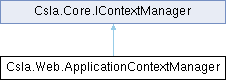
Public Member Functions | |
| ApplicationContextManager () | |
| Creates an instance of the type. | |
| System.Security.Principal.IPrincipal | GetUser () |
| Gets the current principal. | |
| void | SetUser (System.Security.Principal.IPrincipal principal) |
| IContextDictionary? | GetLocalContext () |
| Gets the local context. | |
| void | SetLocalContext (IContextDictionary? localContext) |
| Sets the local context. | |
| IContextDictionary? | GetClientContext (ApplicationContext.ExecutionLocations executionLocation) |
| Gets the client context. | |
| void | SetClientContext (IContextDictionary? clientContext, ApplicationContext.ExecutionLocations executionLocation) |
| Sets the client context. | |
| Public Member Functions inherited from Csla.Core.IContextManager | |
| void | SetUser (IPrincipal principal) |
| Sets the current principal. | |
Properties | |
| bool | IsValid [get] |
| Gets a value indicating whether this context manager is valid for use in the current environment. | |
| bool | IsStatefulContext [get] |
| Gets a value indicating whether the current runtime is stateful (e.g. WPF, Blazor, etc.). | |
| ApplicationContext? | ApplicationContext [get, set] |
| Gets or sets a reference to the current ApplicationContext. | |
Application context manager that uses HttpContext to store context values.
|
inline |
Creates an instance of the type.
|
inline |
|
inline |
Gets the local context.
Implements Csla.Core.IContextManager.
|
inline |
Gets the current principal.
Implements Csla.Core.IContextManager.
|
inline |
Sets the client context.
| clientContext | Client context. |
| executionLocation |
Implements Csla.Core.IContextManager.
|
inline |
|
inline |
|
getset |
Gets or sets a reference to the current ApplicationContext.
Implements Csla.Core.IContextManager.
|
get |
Gets a value indicating whether the current runtime is stateful (e.g. WPF, Blazor, etc.).
Implements Csla.Core.IContextManager.
|
get |
Gets a value indicating whether this context manager is valid for use in the current environment.
Implements Csla.Core.IContextManager.
 1.16.1