CSLA .NET 10.0.0
A home for your business logic
Loading...
Searching...
No Matches
Csla.Xaml.ObjectStatus Class Reference

Container for other UI controls that exposes various status values from the CSLA .NET business object acting as DataContext. More...

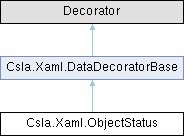
Inheritance diagram for Csla.Xaml.ObjectStatus:
Csla.Xaml.DataDecoratorBase

Public Member Functions

void Refresh ()
 Refreshes the control's property values to reflect the values of the underlying business object.
Public Member Functions inherited from Csla.Xaml.DataDecoratorBase
 DataDecoratorBase ()
 Creates an instance of the object.

Protected Member Functions

override void DataObjectChanged ()
 This method is called when the data object to which the control is bound has changed.
override void DataPropertyChanged (PropertyChangedEventArgs? e)
 This method is called when a property of the data object to which the control is bound has changed.
override void DataBindingListChanged (ListChangedEventArgs e)
 This method is called if the data object is an IBindingList, and the ListChanged event was raised by the data object.
override void DataObservableCollectionChanged (System.Collections.Specialized.NotifyCollectionChangedEventArgs e)
 This method is called if the data object is an INotifyCollectionChanged, and the CollectionChanged event was raised by the data object.
Protected Member Functions inherited from Csla.Xaml.DataDecoratorBase
virtual void DataObservableCollectionChanged (NotifyCollectionChangedEventArgs e)
 This method is called if the data object is an INotifyCollectionChanged, and the CollectionChanged event was raised by the data object.
void FindChildBindings ()
 Scans all child controls of this panel for object bindings, and calls FoundBinding for each binding found.
virtual void FoundBinding (Binding bnd, FrameworkElement control, DependencyProperty prop)
 Called by FindChildBindings each time an object binding is found.

Properties

bool CanCreateObject [get, protected set]
 Exposes the CanCreateObject property of the DataContext business object.
bool CanGetObject [get, protected set]
 Exposes the CanGetObject property of the DataContext business object.
bool CanEditObject [get, protected set]
 Exposes the CanEditObject property of the DataContext business object.
bool CanDeleteObject [get, protected set]
 Exposes the CanDeleteObject property of the DataContext business object.
bool IsDeleted [get, protected set]
 Exposes the IsDeleted property of the DataContext business object.
bool IsDirty [get, protected set]
 Exposes the IsDirty property of the DataContext business object.
bool IsNew [get, protected set]
 Exposes the IsNew property of the DataContext business object.
bool IsSavable [get, protected set]
 Exposes the IsSavable property of the DataContext business object.
bool IsValid [get, protected set]
 Exposes the IsValid property of the DataContext business object.
Properties inherited from Csla.Xaml.DataDecoratorBase
object? DataObject [get]
 Gets a reference to the current data object.

Detailed Description

Container for other UI controls that exposes various status values from the CSLA .NET business object acting as DataContext.

This control provides access to the IsDirty, IsNew, IsDeleted, IsValid and IsSavable properties of a business object. The purpose behind this control is to expose those properties in a way that supports WFP data binding against those values.

Member Function Documentation

◆ DataBindingListChanged()

override void Csla.Xaml.ObjectStatus.DataBindingListChanged ( ListChangedEventArgs e)
inlineprotectedvirtual

This method is called if the data object is an IBindingList, and the ListChanged event was raised by the data object.

Reimplemented from Csla.Xaml.DataDecoratorBase.

◆ DataObjectChanged()

override void Csla.Xaml.ObjectStatus.DataObjectChanged ( )
inlineprotectedvirtual

This method is called when the data object to which the control is bound has changed.

Reimplemented from Csla.Xaml.DataDecoratorBase.

◆ DataObservableCollectionChanged()

override void Csla.Xaml.ObjectStatus.DataObservableCollectionChanged ( System.Collections.Specialized.NotifyCollectionChangedEventArgs e)
inlineprotected

This method is called if the data object is an INotifyCollectionChanged, and the CollectionChanged event was raised by the data object.

◆ DataPropertyChanged()

override void Csla.Xaml.ObjectStatus.DataPropertyChanged ( PropertyChangedEventArgs? e)
inlineprotectedvirtual

This method is called when a property of the data object to which the control is bound has changed.

Reimplemented from Csla.Xaml.DataDecoratorBase.

◆ Refresh()

void Csla.Xaml.ObjectStatus.Refresh ( )
inline

Refreshes the control's property values to reflect the values of the underlying business object.

Property Documentation

◆ CanCreateObject

bool Csla.Xaml.ObjectStatus.CanCreateObject
getprotected set

Exposes the CanCreateObject property of the DataContext business object.

◆ CanDeleteObject

bool Csla.Xaml.ObjectStatus.CanDeleteObject
getprotected set

Exposes the CanDeleteObject property of the DataContext business object.

◆ CanEditObject

bool Csla.Xaml.ObjectStatus.CanEditObject
getprotected set

Exposes the CanEditObject property of the DataContext business object.

◆ CanGetObject

bool Csla.Xaml.ObjectStatus.CanGetObject
getprotected set

Exposes the CanGetObject property of the DataContext business object.

◆ IsDeleted

bool Csla.Xaml.ObjectStatus.IsDeleted
getprotected set

Exposes the IsDeleted property of the DataContext business object.

◆ IsDirty

bool Csla.Xaml.ObjectStatus.IsDirty
getprotected set

Exposes the IsDirty property of the DataContext business object.

◆ IsNew

bool Csla.Xaml.ObjectStatus.IsNew
getprotected set

Exposes the IsNew property of the DataContext business object.

◆ IsSavable

bool Csla.Xaml.ObjectStatus.IsSavable
getprotected set

Exposes the IsSavable property of the DataContext business object.

◆ IsValid

bool Csla.Xaml.ObjectStatus.IsValid
getprotected set

Exposes the IsValid property of the DataContext business object.


The documentation for this class was generated from the following file: