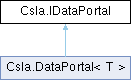
Interface defining the members of the data portal type.
More...
|
| Task< ICslaObject > | CreateAsync (params object?[]? criteria) |
| | Starts an asynchronous data portal operation to create a business object.
|
| Task< ICslaObject > | FetchAsync (params object?[]? criteria) |
| | Starts an asynchronous data portal operation to create a business object.
|
| Task< ICslaObject > | UpdateAsync (ICslaObject obj) |
| | Called by a factory method in a business class or by the UI to update an object.
|
| Task< ICslaObject > | ExecuteAsync (ICslaObject command) |
| | Called by a factory method in a business class or by the UI to execute a command object.
|
| Task< ICslaObject > | ExecuteAsync (params object?[]? criteria) |
| | Execute a command on the logical server.
|
| Task | DeleteAsync (params object?[]? criteria) |
| | Called by a factory method in a business class or by the UI to delete an object.
|
| ICslaObject | Create (params object?[]? criteria) |
| | Called by a factory method in a business class to create a new object, which is loaded with default values from the database.
|
| ICslaObject | Fetch (params object?[]? criteria) |
| | Called by a factory method in a business class to retrieve an object, which is loaded with values from the database.
|
| ICslaObject | Execute (ICslaObject obj) |
| | Called to execute a Command object on the server.
|
| ICslaObject | Execute (params object?[]? criteria) |
| | Execute a command on the logical server.
|
| ICslaObject | Update (ICslaObject obj) |
| | Insert, update or delete an object in the database.
|
| void | Delete (params object?[]? criteria) |
| | Called by a Shared (static in C#) method in the business class to cause immediate deletion of a specific object from the database.
|
Interface defining the members of the data portal type.
◆ Create()
| ICslaObject Csla.IDataPortal.Create |
( |
params object??[] | criteria | ) |
|
Called by a factory method in a business class to create a new object, which is loaded with default values from the database.
- Parameters
-
| criteria | Object-specific criteria. |
- Returns
- A new object, populated with default values.
Implemented in Csla.DataPortal< T >.
◆ CreateAsync()
| Task< ICslaObject > Csla.IDataPortal.CreateAsync |
( |
params object??[] | criteria | ) |
|
Starts an asynchronous data portal operation to create a business object.
- Parameters
-
| criteria | Criteria describing the object to create. |
Implemented in Csla.DataPortal< T >.
◆ Delete()
| void Csla.IDataPortal.Delete |
( |
params object??[] | criteria | ) |
|
Called by a Shared (static in C#) method in the business class to cause immediate deletion of a specific object from the database.
- Parameters
-
| criteria | Object-specific criteria. |
Implemented in Csla.DataPortal< T >.
◆ DeleteAsync()
| Task Csla.IDataPortal.DeleteAsync |
( |
params object??[] | criteria | ) |
|
Called by a factory method in a business class or by the UI to delete an object.
- Parameters
-
| criteria | Object-specific criteria. |
Implemented in Csla.DataPortal< T >.
◆ Execute() [1/2]
Called to execute a Command object on the server.
To be a Command object, the object must inherit from CommandBase.
Note that this method returns a reference to the updated business object. If the server-side DataPortal is running remotely, this will be a new and different object from the original, and all object references MUST be updated to use this new object.
On the server, the Command object's DataPortal_Execute() method will be invoked and on an ObjectFactory the Execute method will be invoked. Write any server-side code in that method.
- Parameters
-
| obj | A reference to the Command object to be executed. |
- Returns
- A reference to the updated Command object.
- Exceptions
-
| ArgumentNullException | obj is null. |
◆ Execute() [2/2]
| ICslaObject Csla.IDataPortal.Execute |
( |
params object??[] | criteria | ) |
|
Execute a command on the logical server.
- Parameters
-
| criteria | Criteria provided to the command object. |
- Returns
- The resulting command object.
Implemented in Csla.DataPortal< T >.
◆ ExecuteAsync() [1/2]
Called by a factory method in a business class or by the UI to execute a command object.
- Parameters
-
| command | Command object to execute. |
- Exceptions
-
| ArgumentNullException | command is null. |
◆ ExecuteAsync() [2/2]
| Task< ICslaObject > Csla.IDataPortal.ExecuteAsync |
( |
params object??[] | criteria | ) |
|
Execute a command on the logical server.
- Parameters
-
| criteria | Criteria provided to the command object. |
- Returns
- The resulting command object.
Implemented in Csla.DataPortal< T >.
◆ Fetch()
| ICslaObject Csla.IDataPortal.Fetch |
( |
params object??[] | criteria | ) |
|
Called by a factory method in a business class to retrieve an object, which is loaded with values from the database.
- Parameters
-
| criteria | Object-specific criteria. |
- Returns
- An object populated with values from the database.
Implemented in Csla.DataPortal< T >.
◆ FetchAsync()
| Task< ICslaObject > Csla.IDataPortal.FetchAsync |
( |
params object??[] | criteria | ) |
|
Starts an asynchronous data portal operation to create a business object.
- Parameters
-
| criteria | Criteria describing the object to create. |
Implemented in Csla.DataPortal< T >.
◆ Update()
Insert, update or delete an object in the database.
Note that this method returns a reference to the updated business object. If the server-side DataPortal is running remotely, this will be a new and different object from the original, and all object references MUST be updated to use this new object.
- Parameters
-
| obj | A reference to the business object to be updated. |
- Returns
- A reference to the updated business object.
- Exceptions
-
| ArgumentNullException | obj is null. |
◆ UpdateAsync()
Called by a factory method in a business class or by the UI to update an object.
- Parameters
-
- Exceptions
-
| ArgumentNullException | obj is null. |
The documentation for this interface was generated from the following file:

 1.16.1